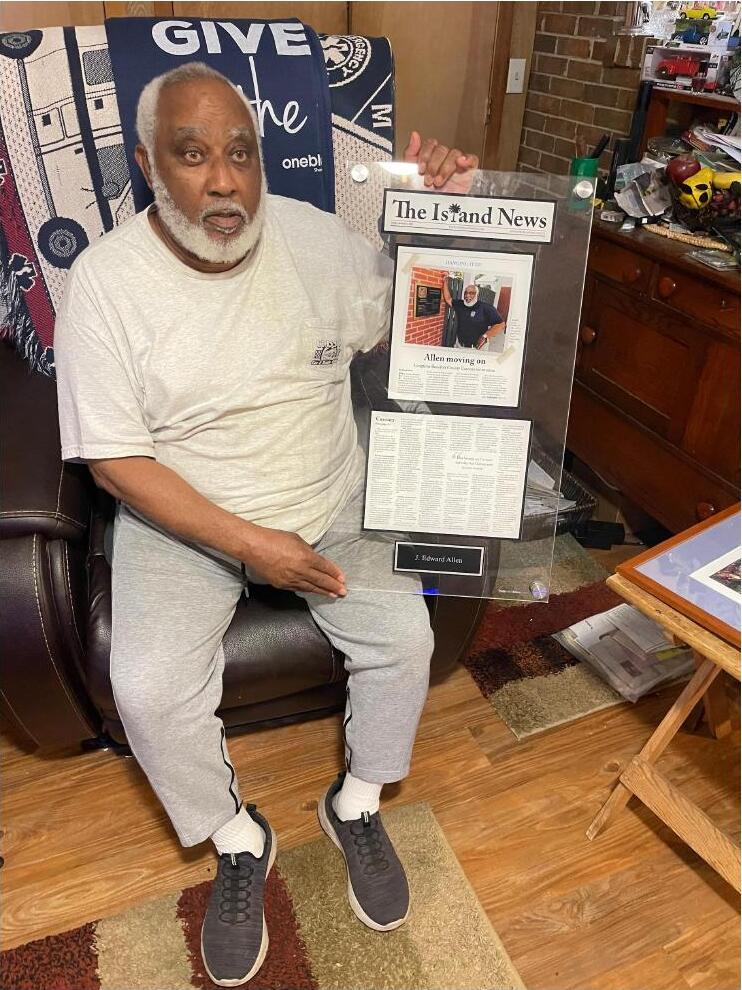
Mr. Ed Allen's decades of service to Beaufort County reflect a legacy of public leadership, historical continuity, and community resilience spanning generations. During a recent visit to his home, Mr. Allen shared stories of his career, family history, and the traditions of service that continue to shape Beaufort County today.
A Pioneer in Public Service
Mr. Allen retired after 33 years as Director of Beaufort County Emergency Medical Services, having begun his service in 1974 when funeral homes ceased operating ambulances. He became the first known Black EMS Director of a county in South Carolina, Georgia, North Carolina, and Florida, establishing Beaufort County's first EMS department and training generations of emergency responders.
In addition to his EMS work, he served as Deputy Coroner alongside Curt Copeland for nearly three decades before becoming the county's elected Coroner in 2008. He later served 12 years in that role, expanding the office into one of the most respected in the state. According to local historical accounts, he is recognized as the second Black Coroner in Beaufort County's history, following Renty Graves, who rests in Beaufort National Cemetery.
Educational Path and Career Foundations
Mr. Allen graduated from Robert Smalls High School before enrolling at Xavier University of Louisiana in New Orleans as a pharmacy major. Realizing limited opportunities for private practice in the area at the time, he redirected his path and studied at the Cincinnati College of Mortuary Science.
His early career included work at Leevy's Funeral Home in Columbia before returning to Beaufort in 1972. He eventually partnered in the funeral home business he first learned as a high school student, blending his training in mortuary sciences with his long-standing commitment to community service.
Family Heritage and Community Roots
Equally powerful was hearing Mr. Allen recount his family history, which reflects the endurance and achievements of Black families throughout Beaufort County. His grandfather, Willie Pigler, was a self-educated veterinarian and landowner who operated a hog farm on the very land where Mr. Allen lives today. Mr. Pigler was also the county's only veterinarian until Dr. Pratt arrived. In addition to his agricultural work, he owned and operated a nightclub, shrimp hole, and liquor store.
Those who knew him often remembered his entrepreneurship, self-sufficiency, and strong understanding of state and county business regulations. Mr. Allen also shared that his great-grandfather, Arthur Pigler, moved from Sumter to Beaufort to work phosphate mines in the river and adopted his former enslaver's surname after emancipation in pursuit of greater employment opportunities.
His lineage includes veterans of the United States Colored Troops whose service helped secure freedom and dignity for generations that followed. Mr. Allen's father-in-law, Dr. Alonzo Stephens, was among the first Black men to earn a Ph.D. from the University of Pennsylvania. Dr. Stephens chaired the History Department at Tennessee State University, taught at Savannah State, and began his education at Bethune-Cookman College, where he personally drove Dr. Mary McLeod Bethune as both an informal driver and close companion.
Reflections and Gratitude
Mr. Allen's reflections consistently connected personal memory to broader public history. Whether describing how caskets floated to the surface following Hurricane Matthew in 2016 or recalling evenings when Beaufort families gathered along the Bluff to catch cool breezes beneath exceptionally bright stars and moonlit skies before air conditioning became common, his stories illustrated the intersection between everyday life and historical change.
His life and family heritage serve as reminders that public service is not only professional, but also ancestral. His example continues to demonstrate to younger generations that resilience, integrity, and service remain living traditions worthy of preservation and continuation.
On behalf of the HBCUI National Park Service Internship Program, gratitude is extended to Mr. Allen for his generosity, time, and willingness to preserve and share these stories. His legacy stands not only as personal history, but as part of the broader communal inheritance of Beaufort County and the Lowcountry.